
How to Choose the Right Action Verbs, Avoid Weak Expressions and Improve Requirements Quality Using EARS Notation
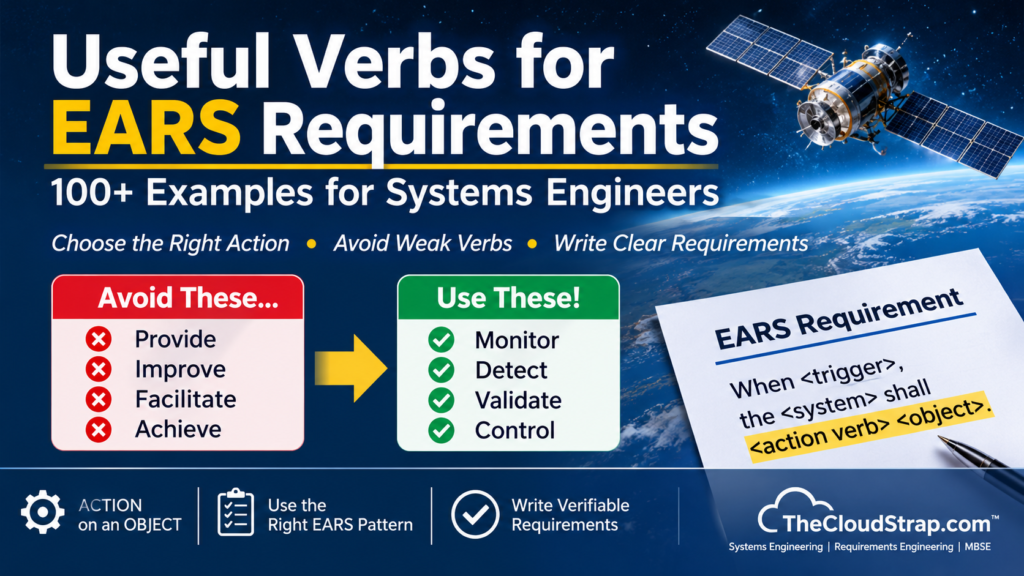
Writing a good engineering requirement is not simply about describing what a system should do. It is about expressing a specific, meaningful, and verifiable system behaviour in a way that every stakeholder, systems engineer, designer, software developer, and verification engineer can understand consistently.
One of the most important elements of a well-written requirement is the verb.
Consider these two requirements:
Requirement 1:
“The Satellite Management System shall provide communication reliability.”
Requirement 2:
“The Satellite Management System shall monitor the communication link status.”
Both requirements sound reasonable, but they communicate very different levels of engineering detail.
The first requirement describes a desired property without explaining what the system must actually do. The second identifies a specific system action and the object on which that action is performed.
This is why selecting the right verb is an essential part of requirements engineering.
The Easy Approach to Requirements Syntax (EARS) provides a structured way of writing requirements using predefined sentence patterns. However, selecting the correct EARS pattern is only one part of the process. Engineers must also choose meaningful action verbs that clearly describe the required system behaviour.
This article explores useful verbs for EARS requirements, explains how to identify weak verbs, provides practical examples from aerospace and satellite engineering, and presents a reusable vocabulary for writing better system and software requirements.
1. Why Are Verbs Important in Requirements Engineering?
A requirement normally describes an obligation that a system must fulfil.
The verb communicates the action or behaviour that the system is expected to perform.
For example:
- Detect an intruder.
- Monitor battery voltage.
- Transmit telemetry data.
- Validate a telecommand.
- Maintain communication links.
- Control payload temperature.
- Record operational events.
Each example identifies a specific action and an object associated with that action.
Compare these with:
- Provide security.
- Improve reliability.
- Enhance performance.
- Facilitate communication.
- Achieve operational efficiency.
These statements describe desired outcomes or properties without necessarily identifying an actual system action.
This creates problems during system architecture development, design, and verification.
A designer may struggle to determine what functionality must be implemented, while a verification engineer may struggle to establish objective acceptance criteria.
Therefore, a useful principle in requirements engineering is:
Start with an action verb that describes what the system must do, followed by a clearly identified object on which the action is performed.
2. The ACTION on an OBJECT Principle
A practical approach to naming system needs and Use Cases is to follow the:
ACTION + OBJECT
structure.
The action represents what the system must do, while the object identifies what the action is applied to.
For example:
| Action | Object | Resulting name |
|---|---|---|
| Detect | Intruder | Detect intruder |
| Conserve | Water | Conserve water |
| Dispense | Ticket | Dispense ticket |
| Monitor | Battery voltage | Monitor battery voltage |
| Validate | Telecommand | Validate telecommand |
| Transmit | Telemetry data | Transmit telemetry data |
| Maintain | Communication link | Maintain communication link |
| Record | Fault event | Record fault event |
This approach is particularly useful when naming:
- System Needs.
- Stakeholder Needs.
- System Use Cases.
- Subsystem Use Cases.
- Functional requirements.
- System capabilities.
However, remember that a Need or Use Case name is not necessarily a complete EARS requirement.
For example:
Use Case name:
Validate telecommand.
Corresponding EARS requirement:
“When a telecommand is received from the Ground Control Segment, the Satellite Management System shall validate the telecommand before execution.”
The Use Case name identifies the capability, while the EARS requirement defines the conditions and required behaviour.
3. How to Check Whether a Word Is a Useful Verb
Not every word that appears at the beginning of a requirement is an appropriate action verb.
A simple technique can help determine whether a word is genuinely functioning as a verb.
The Verb Test
Take the proposed action word and perform two checks:
- Add the word “to” before it.
- Add “-ing” to the end of it.
Both forms should make grammatical sense as verb forms.
Consider the following examples:
| Word | “To” + word | Word + “ing” | Result |
|---|---|---|---|
| Conserve | To conserve ✓ | Conserving ✓ | Useful verb |
| Detect | To detect ✓ | Detecting ✓ | Useful verb |
| Validate | To validate ✓ | Validating ✓ | Useful verb |
| Maintain | To maintain ✓ | Maintaining ✓ | Useful verb |
| Safety | To safety ✗ | Safetying ✗ | Not an action verb |
| Reliability | To reliability ✗ | Reliabilitying ✗ | Not an action verb |
For example:
Weak name: Safety check.
Improved name: Check safety interlock.
The improved name begins with an actual action verb and identifies the object.
This test is a useful initial screening technique. It does not replace checking whether the verb communicates the intended engineering behaviour.
4. Useful Verbs for Writing EARS Requirements
A practical vocabulary of action verbs makes requirements development more consistent.
The following vocabulary is based on the 227 useful verbs listed in the uploaded TheCloudStrap.com guidance document, Naming Needs & Use Cases – Useful Verbs, Version 1.0, dated 5 January 2025.
The list is not exhaustive. Engineers can introduce additional verbs when appropriate, provided they pass the verb test and describe a meaningful action.
4.1 Commonly Used Verbs in Systems Engineering
The following verbs are particularly useful when developing system and subsystem requirements.
| Verb | Engineering application |
|---|---|
| Activate | Activate a subsystem or function |
| Adapt | Adapt system behaviour |
| Analyse | Analyse received information |
| Calculate | Calculate a parameter |
| Check | Check a condition or status |
| Control | Control a system function |
| Create | Create a data record |
| Define | Define a configuration |
| Detect | Detect a fault or event |
| Determine | Determine a system parameter |
| Diagnose | Diagnose a failure |
| Display | Display information |
| Generate | Generate a signal or event |
| Identify | Identify a system condition |
| Initiate | Initiate an operation |
| Inspect | Inspect an input or condition |
| Isolate | Isolate a faulty subsystem |
| Maintain | Maintain a specified condition |
| Manage | Manage an operational process |
| Measure | Measure a physical parameter |
| Monitor | Monitor a system condition |
| Notify | Notify an operator or subsystem |
| Observe | Observe a system parameter |
| Operate | Operate a system function |
| Perform | Perform a defined operation |
| Prevent | Prevent an unwanted action |
| Process | Process received data |
| Protect | Protect a system component |
| Receive | Receive an external message |
| Record | Record an operational event |
| Regulate | Regulate a physical parameter |
| Reject | Reject invalid information |
| Release | Release a controlled resource |
| Remove | Remove an identified condition |
| Report | Report system information |
| Reset | Reset a system function |
| Route | Route information |
| Select | Select an operational mode |
| Send | Send a message |
| Sense | Sense a physical condition |
| Start | Start an operation |
| Stop | Stop an operation |
| Store | Store information |
| Supply | Supply information or resources |
| Transfer | Transfer data |
| Transmit | Transmit a signal or message |
| Update | Update a configuration |
| Validate | Validate received information |
| Verify | Verify a specified condition |
| Warn | Warn an operator |
| Control | Control a defined system parameter |
These verbs can help engineers describe system functionality without introducing unnecessary implementation details.
4.2 Verbs for Data and Information Management
These are useful when developing requirements for software-intensive systems, onboard data handling, satellite management and communication systems.
| Verb | Typical object |
|---|---|
| Access | Configuration data |
| Calculate | Position information |
| Check | Data integrity |
| Collate | Telemetry information |
| Communicate | System status |
| Convert | Data format |
| Convey | Operational information |
| Create | Data record |
| Define | Data structure |
| Display | System status |
| Identify | Data source |
| Input | Configuration parameter |
| Log | Fault event |
| Obtain | Sensor information |
| Output | Processed data |
| Receive | Telecommand |
| Record | Operational event |
| Store | Telemetry data |
| Submit | Command request |
| Transfer | Payload data |
| Transmit | Telemetry message |
| Update | Configuration parameter |
| Validate | Received data |
| Verify | Data integrity |
4.3 Verbs for Control and Operational Behaviour
These verbs are useful for flight control systems, engine control systems, payload management systems and other real-time embedded systems.
| Verb | Typical object |
|---|---|
| Activate | Control function |
| Adjust | Control parameter |
| Align | Sensor reference |
| Apply | Control demand |
| Balance | System load |
| Control | Engine speed |
| Detect | Mode transition |
| Direct | Actuator movement |
| Enable | System function |
| Inhibit | Unwanted operation |
| Initiate | Control sequence |
| Limit | Operating parameter |
| Maintain | Operational state |
| Modulate | Output signal |
| Move | Actuator |
| Position | Control surface |
| Prevent | Unintended activation |
| Regulate | System pressure |
| Release | Control command |
| Select | Operating mode |
| Start | Engine sequence |
| Steer | Vehicle direction |
| Stop | Operating sequence |
| Switch | Operational mode |
| Trigger | Protection function |
Some verbs, such as enable, inhibit, and switch, are useful in engineering requirements even though they should always be associated with a clearly identified object and defined behaviour.
5. Verbs to Avoid in Requirements Writing
Not all verbs are equally useful.
Some verbs describe desired properties, performance expectations or general outcomes rather than specific system actions.
The uploaded TheCloudStrap.com guidance identifies the following 15 verbs as not-so-useful:
| Verbs to avoid | Why they can be problematic |
|---|---|
| Achieve | Does not identify the actual system action. |
| Allow | Describes permission rather than system behaviour. |
| Appoint | Often does not describe a system function. |
| Confirm | Can be ambiguous without identifying what is confirmed. |
| Cope | Does not define an observable action. |
| Enhance | Does not identify a measurable action. |
| Encourage | Describes an influence rather than system behaviour. |
| Exceed | Does not necessarily identify the intended system action. |
| Facilitate | Does not specify what the system actually does. |
| Improve | Describes a desired outcome without defining the action. |
| Meet | Often refers to an unspecified target or property. |
| Promote | Does not identify a concrete system action. |
| Provide | Can hide the actual functionality required. |
| Satisfy | Does not identify the action or acceptance criteria. |
These words are not universally prohibited in every engineering document. Their suitability depends on context.
For example, “provide” may be perfectly reasonable in a requirement when it identifies a specific, defined service or interface capability. However, it becomes weak when used as a substitute for an actual action.
5.1 Why Do These Verbs Cause Problems?
Consider:
“The Satellite Management System shall provide reliability.”
What does this mean?
Does the system need to:
- Detect faults?
- Isolate failed components?
- Recover from communication failures?
- Maintain redundant communication links?
- Record fault events?
- Restart failed software components?
The requirement does not identify the required behaviour.
Another example:
“The Payload Management System shall facilitate payload availability.”
This statement describes a desired quality attribute but does not identify the actual system responsibility.
A better approach is to identify the actions required to achieve the desired outcome.
For example:
- Detect payload faults.
- Isolate faulty payload components.
- Monitor payload operational status.
- Restore payload operation following an approved recovery sequence.
The quality attribute, such as availability, should be captured separately using measurable system-level or quality requirements.
6. How to Rewrite Weak Verbs into Strong Engineering Requirements
The following examples demonstrate how to replace vague expressions with concrete actions.
| Weak expression | Improved action | Example requirement |
|---|---|---|
| Provide reliability | Detect, isolate, recover | The System shall detect the defined communication faults. |
| Facilitate availability | Maintain, restore | The System shall restore communication following the defined recovery sequence. |
| Allow user access | Authenticate, grant | The System shall authenticate each user access request. |
| Enhance performance | Reduce, optimise | The System shall reduce the processing response time to the specified limit. |
| Confirm order | Verify, acknowledge | The System shall verify each received command before execution. |
| Improve safety | Detect, inhibit, protect | The System shall inhibit actuator activation when the defined safety interlock is active. |
| Achieve accuracy | Measure, calculate, maintain | The System shall calculate the measured position within the specified accuracy limits. |
Notice that the improved requirements identify an actual action.
The final requirement must still define sufficient conditions, thresholds and acceptance criteria to make the behaviour verifiable.
7. Combining Useful Verbs with EARS Patterns
The next step is to combine appropriate action verbs with the five primary EARS patterns.
A good verb identifies the system response, while the EARS pattern establishes when that response is required.
7.1 Ubiquitous Requirements
Syntax:
The <System Name> shall <Action Verb> <Object>.
Examples:
- The Satellite Management System shall monitor the onboard battery voltage.
- The Flight Control System shall maintain the commanded aircraft pitch angle within the approved operational limits.
- The Payload Management System shall record payload operational events.
- The Network Management System shall maintain a unique identifier for each configured communication link.
Useful verbs: Monitor, maintain, record, control, calculate, store, identify and manage.
7.2 Event-Driven Requirements
Syntax:
When <Trigger>, the <System Name> shall <Action Verb> <Object>.
Examples:
- When a valid telecommand is received, the Satellite Management System shall validate the telecommand before execution.
- When a payload activation command is received, the Payload Management System shall initiate the payload activation sequence.
- When the aircraft landing gear is commanded to extend, the Landing Gear Control System shall initiate the landing gear extension sequence.
- When a communication session is established, the Network Management System shall record the session start time.
Useful verbs: Receive, validate, initiate, activate, record, transmit, calculate, notify, and execute.
7.3 State-Driven Requirements
Syntax:
While <State>, the <System Name> shall <Action Verb> <Object>.
Examples:
- While the satellite is in Safe Mode, the Satellite Management System shall inhibit non-essential payload operations.
- While the aircraft is in flight, the Flight Control System shall maintain the commanded aircraft attitude within the approved operational limits.
- While the payload is in Imaging Mode, the Payload Management System shall monitor the payload temperature.
- While the communication link is established, the Network Management System shall monitor the link operational status.
Useful verbs: Maintain, monitor, control, inhibit, regulate, protect and operate.
7.4 Unwanted Behaviour Requirements
Syntax:
If <Unwanted Condition>, then the <System Name> shall <Action Verb> <Object>.
Examples:
- If the received telecommand fails validation, then the Satellite Management System shall reject the telecommand.
- If the payload temperature exceeds the configured maximum operating limit, then the Payload Management System shall initiate the defined thermal protection response.
- If the airspeed sensor failure flag is set, then the Flight Control System shall reject the invalid airspeed measurement.
- If the communication link loss flag is set, then the Network Management System shall generate a communication failure notification.
Useful verbs: Detect, reject, inhibit, isolate, stop, prevent, warn, notify, protect and recover.
7.5 Optional Feature Requirements
Syntax:
Where <Optional Feature>, the <System Name> shall <Action Verb> <Object>.
Examples:
- Where the satellite includes an optical payload, the Payload Management System shall control the optical payload operational mode.
- Where redundant communication links are installed, the Network Management System shall monitor the operational status of each configured link.
- Where the aircraft includes an automatic landing capability, the Flight Control System shall execute the defined automatic landing control functions.
Useful verbs: Control, monitor, activate, manage, select, transmit and operate.
8. Choosing the Right Verb: Commonly Confused Engineering Verbs
Some engineering verbs appear similar but communicate different behaviours.
Selecting the correct one is important because a small wording difference can change the intended system functionality.
| Verb | Meaning | Example |
|---|---|---|
| Monitor | Observe a parameter or condition over time. | Monitor battery voltage. |
| Measure | Determine the value of a physical parameter. | Measure battery voltage. |
| Calculate | Derive a value using inputs and a defined method. | Calculate battery state of charge. |
| Determine | Establish a value or condition. | Determine the operating mode. |
| Detect | Identify the occurrence or presence of something. | Detect a communication failure. |
| Identify | Establish the identity of an object or condition. | Identify the source of a telecommand. |
| Validate | Check whether information satisfies defined acceptance criteria. | Validate a received telecommand. |
| Verify | Establish whether a defined condition or result is satisfied. | Verify the integrity of a configuration. |
| Control | Govern or regulate system behaviour. | Control engine speed. |
| Maintain | Keep a condition within specified limits or preserve a state. | Maintain cabin pressure. |
| Regulate | Adjust a parameter to achieve a specified operating condition. | Regulate fuel pressure. |
| Record | Capture information for later retrieval. | Record fault events. |
| Log | Store an event or message in a defined log. | Log communication failures. |
| Notify | Inform a defined recipient or subsystem. | Notify the ground operator. |
| Warn | Communicate the existence of a potential hazard or condition. | Warn the operator of an impending thermal limit. |
| Reject | Refuse to accept an invalid item or request. | Reject an invalid telecommand. |
| Inhibit | Prevent a specified operation from occurring. | Inhibit payload activation. |
The choice of verb should reflect the intended system behaviour, not simply the engineer’s preferred writing style.
9. Practical Example: Developing an EARS Requirement Set for a Satellite Payload
Let’s consider a satellite payload that supports imaging operations.
The system includes a Payload Management System responsible for controlling payload activation, monitoring temperature, processing commands and managing operational states.
A weak requirement might be:
“The Payload Management System shall provide safe and reliable payload operation.”
This statement does not identify the actual functionality required.
A better approach is to decompose the desired behaviour into action-oriented requirements.
| ID | EARS type | Requirement |
|---|---|---|
| PAY-001 | Ubiquitous | The Payload Management System shall monitor the payload temperature. |
| PAY-002 | Ubiquitous | The Payload Management System shall record payload operational events. |
| PAY-003 | Event-driven | When a valid payload activation command is received, the Payload Management System shall initiate the payload activation sequence. |
| PAY-004 | Event-driven | When a payload deactivation command is received, the Payload Management System shall initiate the payload deactivation sequence. |
| PAY-005 | State-driven | While the payload is in Imaging Mode, the Payload Management System shall monitor the configured imaging operational parameters. |
| PAY-006 | Unwanted behaviour | If the payload temperature exceeds the configured maximum operating limit, then the Payload Management System shall initiate the defined thermal protection response. |
| PAY-007 | Unwanted behaviour | If a received payload command fails validation, then the Payload Management System shall reject the command. |
| PAY-008 | Optional feature | Where the satellite includes an optical payload, the Payload Management System shall control the optical payload operational mode. |
This example demonstrates how selecting appropriate verbs helps establish a clear functional baseline.
Each requirement describes a specific system action and can be developed further into lower-level subsystem and software requirements.
The requirements can also be linked to SysML activity diagrams, state machines, block definitions, internal block diagrams, and verification procedures.
10. Useful Verbs and Their Relationship with SysML Modelling
Useful action verbs also play an important role in Model-Based Systems Engineering (MBSE).
In SysML, requirements, use cases, activities, and operations describe different aspects of system behaviour.
Using consistent action verbs across these artefacts improves model readability and traceability.
10.1 Use Case Naming
Use Case names should generally start with an action verb.
Examples:
- Monitor payload temperature.
- Validate telecommand.
- Activate payload.
- Transmit telemetry.
- Manage communication link.
- Detect sensor failure.
Avoid vague names such as:
- Payload management.
- Communication handling.
- System operation.
- Safety functionality.
10.2 Activity Diagram Naming
Activity names should describe the behaviour being performed.
Examples:
- Receive Telecommand.
- Validate Command.
- Calculate Position.
- Monitor Temperature.
- Generate Telemetry.
- Activate Payload.
- Record Fault Event.
This makes the activity diagram easier to understand and relate to functional requirements.
10.3 Block and Interface Naming
Action verbs can also be useful when identifying system responsibilities and interface operations.
For example:
- Receive Telecommand.
- Transmit Telemetry.
- Provide Status Information.
- Validate Configuration Data.
- Update Operational Mode.
However, a block name usually identifies a structural element rather than an action. Avoid forcing action-oriented naming onto every model element.
The naming convention should reflect the purpose of the model element.
10.4 Requirements Traceability
Consider the following traceability chain:
Stakeholder Need: Operate satellite payload.
Use Case: Activate payload.
System Requirement: When a valid payload activation command is received, the Satellite Management System shall initiate the payload activation sequence.
Subsystem Requirement: When the payload activation sequence is initiated, the Payload Management System shall enable the payload power interface.
Software Requirement: When the payload activation request is accepted, the Payload Control Software shall set the payload activation control output to the configured active value.
The same fundamental action is maintained throughout the decomposition, while each requirement defines the responsibility of its allocated system element.
The decomposition must still preserve the original stakeholder intent and be supported by appropriate architecture and interface definitions.
11. Practical Checklist for Selecting Useful Verbs
Before approving a requirement, ask the following questions.
Verb selection
- Does the requirement start with a meaningful action verb?
- Does the verb pass the “to + verb” and “-ing” test?
- Does the verb describe an actual system responsibility?
- Does it avoid vague or outcome-only expressions?
Object identification
- Is the object of the action clearly identified?
- Is the object a system parameter, message, event, command, component or condition?
- Is the object consistent with the system architecture?
EARS structure
- Is the correct EARS pattern selected?
- Is the triggering event clearly defined?
- Are operational states clearly identified?
- Are abnormal conditions explicitly described?
- Is SHALL used to express the mandatory obligation?
Verifiability
- Can the action be demonstrated?
- Is the expected response observable?
- Are measurable acceptance criteria included where necessary?
- Can a verification procedure be developed from the requirement?
Requirements quality
- Is the requirement atomic?
- Is it unambiguous?
- Is it technically feasible?
- Does it avoid unnecessary design details?
- Is it traceable to its source?
12. Conclusion: Good Requirements Start with the Right Verbs
Writing high-quality engineering requirements requires more than selecting the correct EARS sentence pattern.
The action verb is equally important because it communicates what the system is actually required to do.
Words such as Detect, Monitor, Calculate, Validate, Control, Maintain, Transmit, Record and Regulate help engineers describe concrete system behaviour.
Conversely, expressions such as Provide Reliability, Enhance Performance, Facilitate Availability and Achieve Safety can introduce ambiguity when they fail to identify an actual system action.
The ACTION on an OBJECT principle provides a simple starting point for selecting appropriate verbs and naming Needs and Use Cases.
Combining that principle with EARS patterns gives engineers a consistent approach to expressing mandatory system behaviour under defined conditions.
For systems engineers working in aerospace, defence, automotive, satellite engineering and other safety-critical industries, developing a disciplined action-oriented writing style can significantly improve the clarity and verifiability of requirements.
Remember: A good requirement should not simply describe what outcome is desirable. It should clearly identify what the system shall do, when it shall do it, and how the required behaviour can be verified.

This post was published by Admin.
Email: admin@TheCloudStrap.Com